DIFC vs DMCC: Which Dubai Free Zone Is Right for Your Business in 2026?
Author:
Category:
Date:
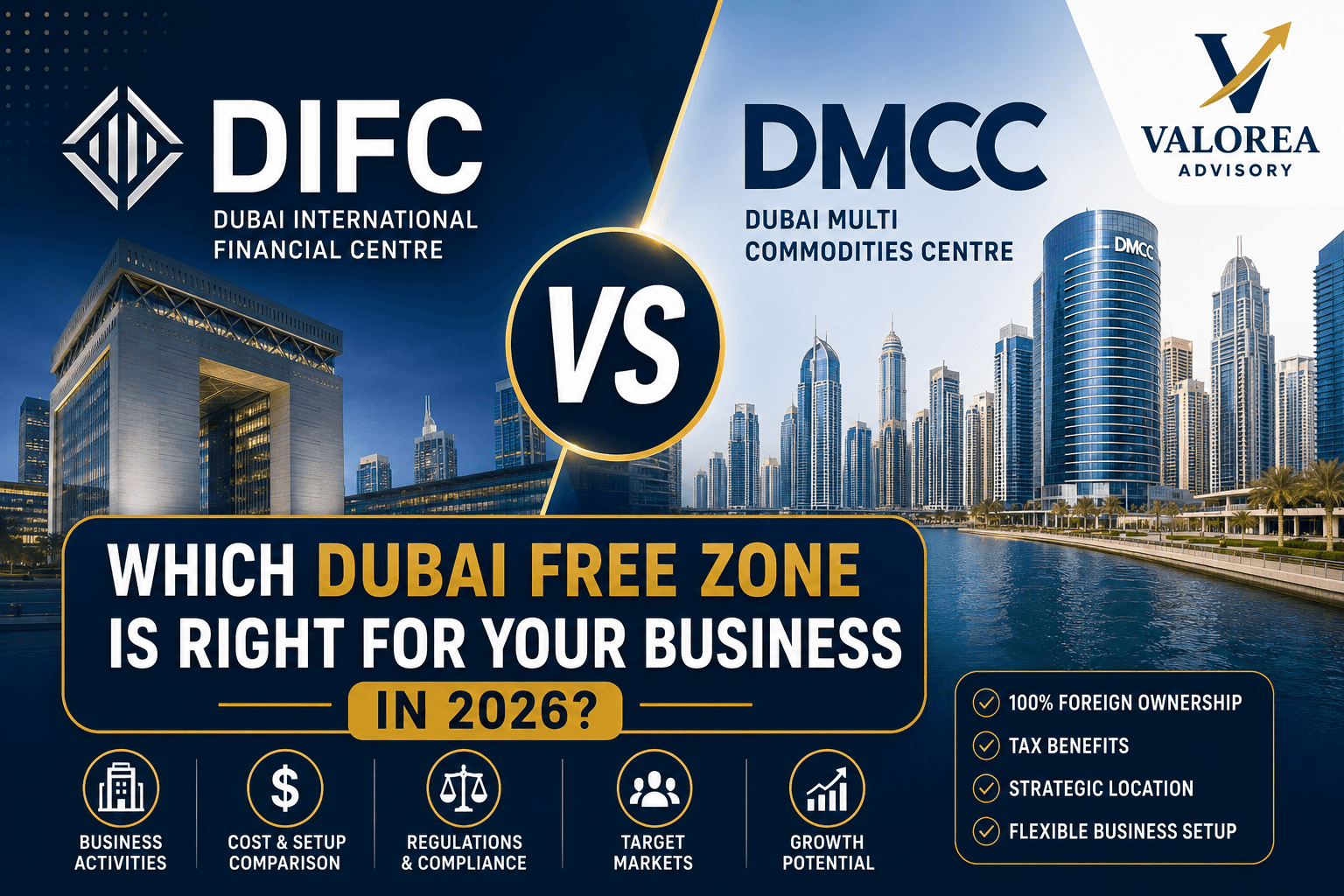
DIFC vs DMCC: Which Dubai Free Zone Is Right for Your Business in 2026?
DIFC and DMCC are two of the most prestigious free zones in Dubai and the wider UAE. Both attract thousands of international businesses every year, yet they serve very different purposes and business profiles. Choosing between them can have a significant impact on your costs, credibility, banking access, and long-term growth.
This guide by Valorea Advisory compares DIFC and DMCC head to head in 2026 so you can make the right decision for your business.
What Is DIFC?
The Dubai International Financial Centre is an onshore financial hub with its own independent legal system based on English common law. Established in 2004, DIFC operates as a jurisdiction within a jurisdiction, with its own courts, civil and commercial laws, and regulatory authority known as the Dubai Financial Services Authority (DFSA).
DIFC is the leading financial centre in the Middle East, Africa, and South Asia region. It is the preferred base for banks, investment firms, hedge funds, family offices, insurance companies, law firms, and professional services firms serving the regional financial market.
What Is DMCC?
The Dubai Multi Commodities Centre is the world's number one free zone, having held the title of Global Free Zone of the Year awarded by the Financial Times fDi Magazine for ten consecutive years. With over 24,000 registered companies, DMCC is the largest free zone in Dubai and one of the most diverse in terms of permitted business activities.
DMCC is headquartered in the Jumeirah Lakes Towers district and supports businesses across commodities trading, finance, technology, professional services, crypto assets, and a wide range of other sectors.
DIFC vs DMCC: Key Differences
Feature | DIFC | DMCC |
|---|---|---|
Legal System | English common law, independent courts | UAE federal law with free zone regulations |
Regulator | DFSA (financial services) | DMCC Authority |
Setup Cost | From AED 30,000 per year | From AED 18,500 per year |
Best For | Finance, investment, law, fintech | Commodities, trading, tech, professional services |
Office Requirement | Physical office required | Flexi-desk available in some packages |
Prestige Level | Ultra premium | Premium |
Business Community | Exclusive, financial sector focused | Large and diverse, 24,000+ companies |
Crypto and Digital Assets | Regulated under DFSA | DMCC Crypto Centre, active ecosystem |
Banking Access | Excellent, global banks on site | Excellent, strong local and international options |
Corporate Tax | 9% on qualifying income over AED 375,000 | 9% on qualifying income over AED 375,000 |
DIFC: Who Should Choose It?
Financial Services and Investment Firms
DIFC is the only choice for businesses that need to be regulated as financial service providers in the UAE. Banks, investment managers, broker-dealers, insurance companies, and fund administrators must be licensed by the DFSA if they want to operate within a regulated framework in the UAE and serve regional clients.
Law Firms and Professional Services
DIFC hosts a large community of international and regional law firms, accounting firms, and management consultancies. The common law environment makes it the natural base for professional service providers who serve financial institutions or need contract enforceability under English law.
Family Offices and Wealth Management
DIFC has become one of the world's top destinations for family offices, private wealth structures, and foundations. Its regulatory environment, legal certainty, and proximity to Gulf capital make it ideal for high-net-worth individuals managing significant assets.
Fintech Companies
DIFC operates the DIFC FinTech Hive, the leading fintech accelerator in the Middle East. Fintech startups and scaleups that need regulatory sandbox access or DFSA licensing gravitate toward DIFC for its ecosystem and credibility.
DMCC: Who Should Choose It?
Commodity Traders
DMCC was purpose-built for commodity trading and remains the world's leading zone for gold, diamonds, tea, coffee, and energy trading. If your business involves physical or paper commodity trading, DMCC offers unmatched infrastructure, warehousing, and a concentrated buyer and seller community.
Technology and Digital Businesses
DMCC supports a thriving technology business community and is home to the DMCC Crypto Centre, one of the UAE's most active ecosystems for blockchain and digital asset companies. Tech startups, SaaS businesses, and digital agencies benefit from the large and diverse business community.
SMEs and Professional Consultants
Unlike DIFC, DMCC offers entry-level packages suitable for smaller businesses and solo founders. The range of permitted activities is broad and the zone's reputation provides strong credibility for SMEs that want a premium Dubai address without the ultra-premium cost of DIFC.
Businesses Needing a Large Visa Allocation
DMCC allows companies to scale their visa allocations as they grow, making it suitable for businesses planning to hire teams in Dubai. The zone's office infrastructure across JLT towers accommodates companies of all sizes.
Cost Comparison: DIFC vs DMCC 2026
Cost Item | DIFC | DMCC |
|---|---|---|
Licence fee (starting) | From AED 30,000 | From AED 18,500 |
Office (minimum) | From AED 80,000 per year | Flexi-desk from AED 15,000 |
Registration fee | AED 8,000 to 15,000 | AED 5,000 to 8,000 |
Investor visa | AED 3,500 to 5,500 | AED 3,500 to 5,500 |
Total first year estimate | AED 120,000 to 200,000+ | AED 40,000 to 80,000 |
Which Has Better Banking Access?
Both DIFC and DMCC enjoy excellent banking access. DIFC has a unique advantage in that major global banks including HSBC, Standard Chartered, Citibank, and many others have branches physically within the DIFC campus. For financial services firms, this proximity is invaluable.
DMCC companies also enjoy strong banking relationships with both local UAE banks and international institutions. The zone's size and reputation mean that banks are familiar with and comfortable onboarding DMCC-licensed entities.
Which Is Better for Crypto and Digital Assets?
Both zones are active in the crypto space but in different ways. DIFC offers regulatory licensing through the DFSA for crypto asset businesses that want to operate as regulated entities. DMCC operates the DMCC Crypto Centre, a dedicated hub for blockchain and digital asset companies that want a business community and infrastructure without necessarily requiring DFSA regulation.
For regulated crypto exchanges or asset managers, DIFC is the right choice. For blockchain startups, crypto trading firms, and Web3 companies, DMCC is generally more accessible and cost effective.
Frequently Asked Questions
Is DIFC better than DMCC?
Neither is universally better. DIFC is the right choice for financial services firms, law firms, and businesses that need English common law jurisdiction or DFSA regulation. DMCC is the better choice for commodity traders, technology companies, SMEs, and businesses that want a prestigious Dubai address at a lower cost.
Can any business set up in DIFC?
No. DIFC focuses on financial services, professional services, and related sectors. Not all business activities are permitted. Companies must meet DFSA or DIFC Authority requirements depending on their activity type.
Is DMCC good for banking?
Yes. DMCC-licensed companies have strong banking acceptance rates with both local UAE banks and international institutions. It is one of the most bank-friendly free zones in the UAE.
Which is cheaper to set up in, DIFC or DMCC?
DMCC is significantly more affordable. DIFC requires a physical office and commands premium costs that can exceed AED 150,000 in the first year including office rent. DMCC entry-level packages are available from AED 18,500 with flexi-desk options.
Can I move from DMCC to DIFC later?
Yes. Some businesses start in DMCC to establish operations and later establish a DIFC entity when they are ready to scale into regulated financial services. Valorea Advisory can structure this transition efficiently.
How Valorea Advisory Can Help
At Valorea Advisory, we help clients evaluate both DIFC and DMCC based on their specific business activity, regulatory requirements, budget, and growth goals. We manage the full setup process in either zone including licence applications, office sourcing, visa processing, and bank account opening.
Email: info@valoreaadvisory.com
WhatsApp: +971 50 927 4399
Website: www.valoreaadvisory.com
Book a free consultation and get a clear recommendation on whether DIFC or DMCC is the right fit for your business.
DIFC vs DMCC: Which Dubai Free Zone Is Right for Your Business in 2026?
DIFC and DMCC are two of the most prestigious free zones in Dubai and the wider UAE. Both attract thousands of international businesses every year, yet they serve very different purposes and business profiles. Choosing between them can have a significant impact on your costs, credibility, banking access, and long-term growth.
This guide by Valorea Advisory compares DIFC and DMCC head to head in 2026 so you can make the right decision for your business.
What Is DIFC?
The Dubai International Financial Centre is an onshore financial hub with its own independent legal system based on English common law. Established in 2004, DIFC operates as a jurisdiction within a jurisdiction, with its own courts, civil and commercial laws, and regulatory authority known as the Dubai Financial Services Authority (DFSA).
DIFC is the leading financial centre in the Middle East, Africa, and South Asia region. It is the preferred base for banks, investment firms, hedge funds, family offices, insurance companies, law firms, and professional services firms serving the regional financial market.
What Is DMCC?
The Dubai Multi Commodities Centre is the world's number one free zone, having held the title of Global Free Zone of the Year awarded by the Financial Times fDi Magazine for ten consecutive years. With over 24,000 registered companies, DMCC is the largest free zone in Dubai and one of the most diverse in terms of permitted business activities.
DMCC is headquartered in the Jumeirah Lakes Towers district and supports businesses across commodities trading, finance, technology, professional services, crypto assets, and a wide range of other sectors.
DIFC vs DMCC: Key Differences
Feature | DIFC | DMCC |
|---|---|---|
Legal System | English common law, independent courts | UAE federal law with free zone regulations |
Regulator | DFSA (financial services) | DMCC Authority |
Setup Cost | From AED 30,000 per year | From AED 18,500 per year |
Best For | Finance, investment, law, fintech | Commodities, trading, tech, professional services |
Office Requirement | Physical office required | Flexi-desk available in some packages |
Prestige Level | Ultra premium | Premium |
Business Community | Exclusive, financial sector focused | Large and diverse, 24,000+ companies |
Crypto and Digital Assets | Regulated under DFSA | DMCC Crypto Centre, active ecosystem |
Banking Access | Excellent, global banks on site | Excellent, strong local and international options |
Corporate Tax | 9% on qualifying income over AED 375,000 | 9% on qualifying income over AED 375,000 |
DIFC: Who Should Choose It?
Financial Services and Investment Firms
DIFC is the only choice for businesses that need to be regulated as financial service providers in the UAE. Banks, investment managers, broker-dealers, insurance companies, and fund administrators must be licensed by the DFSA if they want to operate within a regulated framework in the UAE and serve regional clients.
Law Firms and Professional Services
DIFC hosts a large community of international and regional law firms, accounting firms, and management consultancies. The common law environment makes it the natural base for professional service providers who serve financial institutions or need contract enforceability under English law.
Family Offices and Wealth Management
DIFC has become one of the world's top destinations for family offices, private wealth structures, and foundations. Its regulatory environment, legal certainty, and proximity to Gulf capital make it ideal for high-net-worth individuals managing significant assets.
Fintech Companies
DIFC operates the DIFC FinTech Hive, the leading fintech accelerator in the Middle East. Fintech startups and scaleups that need regulatory sandbox access or DFSA licensing gravitate toward DIFC for its ecosystem and credibility.
DMCC: Who Should Choose It?
Commodity Traders
DMCC was purpose-built for commodity trading and remains the world's leading zone for gold, diamonds, tea, coffee, and energy trading. If your business involves physical or paper commodity trading, DMCC offers unmatched infrastructure, warehousing, and a concentrated buyer and seller community.
Technology and Digital Businesses
DMCC supports a thriving technology business community and is home to the DMCC Crypto Centre, one of the UAE's most active ecosystems for blockchain and digital asset companies. Tech startups, SaaS businesses, and digital agencies benefit from the large and diverse business community.
SMEs and Professional Consultants
Unlike DIFC, DMCC offers entry-level packages suitable for smaller businesses and solo founders. The range of permitted activities is broad and the zone's reputation provides strong credibility for SMEs that want a premium Dubai address without the ultra-premium cost of DIFC.
Businesses Needing a Large Visa Allocation
DMCC allows companies to scale their visa allocations as they grow, making it suitable for businesses planning to hire teams in Dubai. The zone's office infrastructure across JLT towers accommodates companies of all sizes.
Cost Comparison: DIFC vs DMCC 2026
Cost Item | DIFC | DMCC |
|---|---|---|
Licence fee (starting) | From AED 30,000 | From AED 18,500 |
Office (minimum) | From AED 80,000 per year | Flexi-desk from AED 15,000 |
Registration fee | AED 8,000 to 15,000 | AED 5,000 to 8,000 |
Investor visa | AED 3,500 to 5,500 | AED 3,500 to 5,500 |
Total first year estimate | AED 120,000 to 200,000+ | AED 40,000 to 80,000 |
Which Has Better Banking Access?
Both DIFC and DMCC enjoy excellent banking access. DIFC has a unique advantage in that major global banks including HSBC, Standard Chartered, Citibank, and many others have branches physically within the DIFC campus. For financial services firms, this proximity is invaluable.
DMCC companies also enjoy strong banking relationships with both local UAE banks and international institutions. The zone's size and reputation mean that banks are familiar with and comfortable onboarding DMCC-licensed entities.
Which Is Better for Crypto and Digital Assets?
Both zones are active in the crypto space but in different ways. DIFC offers regulatory licensing through the DFSA for crypto asset businesses that want to operate as regulated entities. DMCC operates the DMCC Crypto Centre, a dedicated hub for blockchain and digital asset companies that want a business community and infrastructure without necessarily requiring DFSA regulation.
For regulated crypto exchanges or asset managers, DIFC is the right choice. For blockchain startups, crypto trading firms, and Web3 companies, DMCC is generally more accessible and cost effective.
Frequently Asked Questions
Is DIFC better than DMCC?
Neither is universally better. DIFC is the right choice for financial services firms, law firms, and businesses that need English common law jurisdiction or DFSA regulation. DMCC is the better choice for commodity traders, technology companies, SMEs, and businesses that want a prestigious Dubai address at a lower cost.
Can any business set up in DIFC?
No. DIFC focuses on financial services, professional services, and related sectors. Not all business activities are permitted. Companies must meet DFSA or DIFC Authority requirements depending on their activity type.
Is DMCC good for banking?
Yes. DMCC-licensed companies have strong banking acceptance rates with both local UAE banks and international institutions. It is one of the most bank-friendly free zones in the UAE.
Which is cheaper to set up in, DIFC or DMCC?
DMCC is significantly more affordable. DIFC requires a physical office and commands premium costs that can exceed AED 150,000 in the first year including office rent. DMCC entry-level packages are available from AED 18,500 with flexi-desk options.
Can I move from DMCC to DIFC later?
Yes. Some businesses start in DMCC to establish operations and later establish a DIFC entity when they are ready to scale into regulated financial services. Valorea Advisory can structure this transition efficiently.
How Valorea Advisory Can Help
At Valorea Advisory, we help clients evaluate both DIFC and DMCC based on their specific business activity, regulatory requirements, budget, and growth goals. We manage the full setup process in either zone including licence applications, office sourcing, visa processing, and bank account opening.
Email: info@valoreaadvisory.com
WhatsApp: +971 50 927 4399
Website: www.valoreaadvisory.com
Book a free consultation and get a clear recommendation on whether DIFC or DMCC is the right fit for your business.







What Happens Next?
Our team will carefully review your inquiry and prepare tailored recommendations based on your business activity, preferred jurisdiction, and expansion goals. During our consultation, we will guide you through:
✓ Mainland vs Free Zone options
✓ License selection and business activities
✓ Visa eligibility and requirements
✓ Corporate bank account guidance
✓ Estimated setup costs and timelines
✓ Compliance and regulatory requirements
What Happens Next?
Our team will carefully review your inquiry and prepare tailored recommendations based on your business activity, preferred jurisdiction, and expansion goals. During our consultation, we will guide you through:
✓ Mainland vs Free Zone options
✓ License selection and business activities
✓ Visa eligibility and requirements
✓ Corporate bank account guidance
✓ Estimated setup costs and timelines
✓ Compliance and regulatory requirements
What Happens Next?
Our team will carefully review your inquiry and prepare tailored recommendations based on your business activity, preferred jurisdiction, and expansion goals. During our consultation, we will guide you through:
✓ Mainland vs Free Zone options
✓ License selection and business activities
✓ Visa eligibility and requirements
✓ Corporate bank account guidance
✓ Estimated setup costs and timelines
✓ Compliance and regulatory requirements